VascX Flow-Control Platform Highlighted at VASA as Dialysis Access Field Reconsiders the Cardiac Burden of High-Flow
Leading access physicians linked high-flow AV grafts and fistulas to cardiac burden, high-output heart failure, and the need for a new category of flow-control dialysis access.

SALT LAKE CITY, Utah — May 21, 2026 — VascX, a medical device company developing elastic flow-control implants for dialysis access, today announced that its patented flow-control platform was highlighted at the Vascular Access Society of the Americas conference in Salt Lake City, where leading physicians challenged long-standing assumptions about high-flow dialysis access and its impact on the heart.
Dialysis access is essential for life-sustaining hemodialysis, but arteriovenous access also creates a persistent high-flow vascular circuit. Historically, high-flow access has often been discussed using thresholds such as 1.5 to 2.0 L/min. At VASA, speakers emphasized a more patient-centered standard: high-flow should be judged by its physiologic effect on the heart, not merely by conventional access-flow numbers.
In some patients, high-flow AV fistulas and high-flow AV grafts can contribute to cardiac remodeling, pulmonary hypertension, and high-output heart failure — turning life-sustaining hemodialysis access into a continuous cardiovascular burden.
Dr. John Ross, a leading dialysis access surgeon and founder of the Dialysis Access Institute, directly challenged the traditional framing, asking, “What is high outflow? Some [arbitrary] number that you’re going to measure — 1,500, 2,000 cc — to call it high outflow? We’re asking the wrong entity. Ask the heart…what can you give me?”
That theme was reinforced by Dr. Surendra Shenoy, MD, PhD, Professor Emeritus at Washington University School of Medicine in St. Louis, past president of VASA, keynote speaker, and recipient of the organization’s Lifetime Achievement Award. Dr. Shenoy cited Dr. Ross’s lecture in concurring that high-flow dialysis access can be pathologic in multiple ways, including through its effects on the heart and on the access circuit itself.
The VASA discussion also placed renewed attention on dialysis access flow levels far below the traditional 1.5 L/min high-flow threshold. Dr. Ross cited cardiac MRI evidence showing objective cardiac changes at access flows above approximately 600 mL/min. He also discussed the importance of reducing AV access flow toward approximately 500–600 mL/min while preserving dialysis performance. The point is central: clinically meaningful high-flow physiology, including cardiac remodeling, may begin much lower than many clinicians have historically assumed.
Dr. Ross emphasized that the clinical goal is not simply to reduce access flow, but to preserve dialysis while reducing cardiac burden. “Two things have to happen,” he said. “Number one, the patient needs adequate dialysis. Number two, we must not kill the heart.”
During Dr. Ross’s presentation, he discussed the “VascX patented platform” and presented images of VascX’s “elastic flow-control grafts” and “elastic flow-control stents.” He described VascX’s graft as a flow-control AV graft configuration designed to preserve dialysis-machine performance while reducing the continuous access-flow burden imposed on the heart.
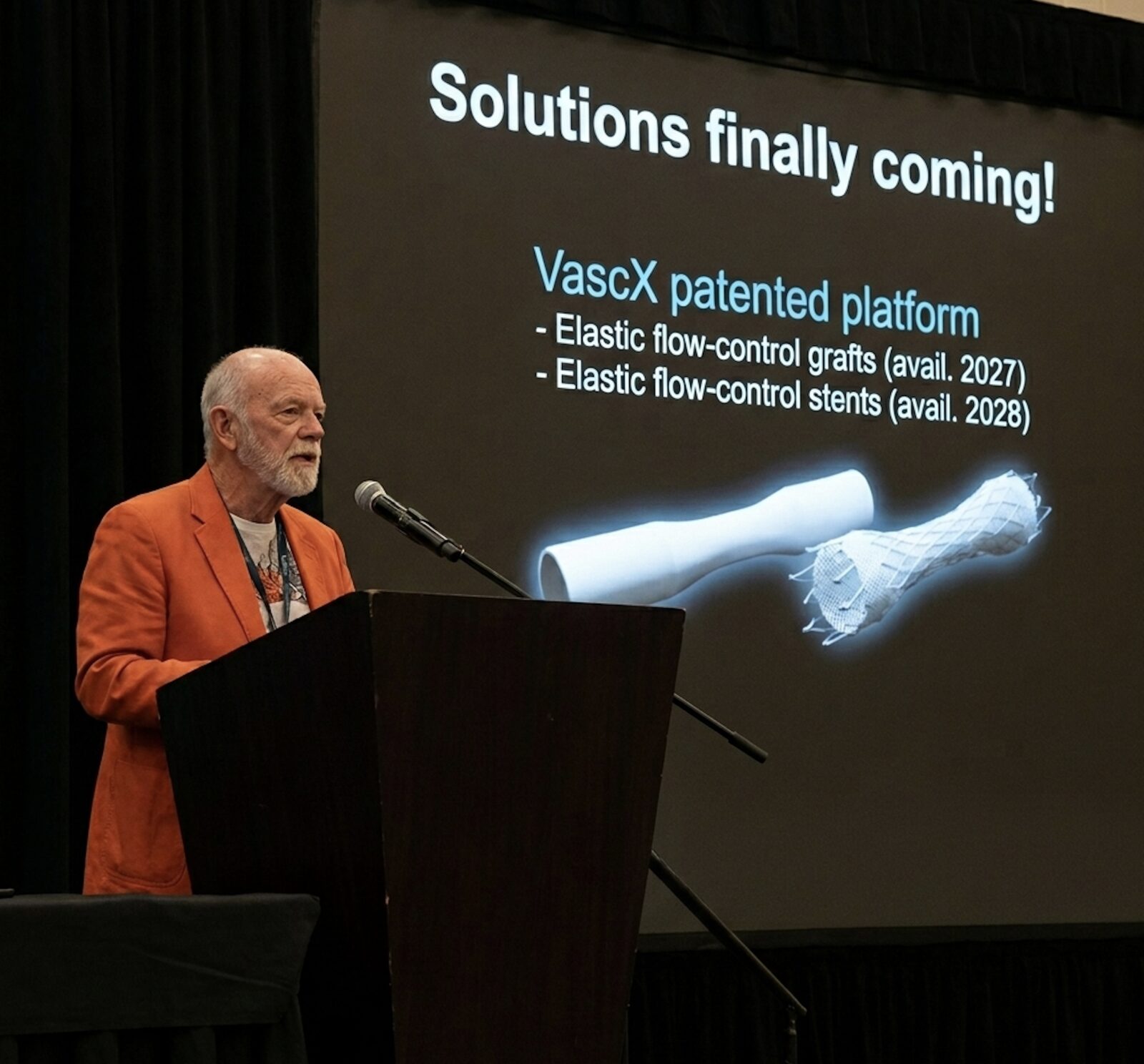
“Here’s a graft. It’ll be a loop graft,” Dr. Ross said. “We’ll have a small attenuated area in the middle. You put the artery needle on one side, the needle on the other side. You have a parallel circuit. So now we’re only running at 500 to 600 cc per minute, but we’re also going to dialyze the patient at anything you want to set the machine on: 300, 400, 500, whatever you want to do.”
For VascX, the 500–600 mL/min range is not an incidental number. It reflects the company’s core design principle: dialysis access should deliver the flow needed for effective treatment without imposing unnecessary continuous high-flow burden on the heart. Dr. Ross’s discussion of cardiac changes around 600 mL/min supports the same emerging framework — that the field may need to reconsider where clinically meaningful high-flow begins. Access flow reduction has traditionally been approached after complications arise; VascX is developing flow-control technology intended to make controlled flow part of the access design itself.
“Dialysis access has traditionally been optimized to maintain or increase flow, but the heart pays the price for that flow every minute of every day,” said Stan Batiste, CEO of VascX. “The VASA discussion captured exactly why VascX exists. The future of access should preserve dialysis performance while bringing access flow closer to what the patient’s body and heart can tolerate.”
Dr. Shenoy’s keynote commentary further supported the broader flow-control thesis. Dr. Shenoy emphasized that adequate dialysis does not necessarily require ever-higher access flow, noting that “if you have a flow of 500, you can get dialysis at whatever flow you need to get without any problems.” He added that “probably you don’t need more flow than 500 in access” and that “there is really no reason to push for more flows” once adequate access function is achieved.
Together, Dr. Ross’s discussion of cardiac MRI evidence and Dr. Shenoy’s keynote commentary point toward a shift in how high-flow AV access may be understood: excessive dialysis access flow is not merely a technical measurement, but a physiologic burden with potential consequences for cardiac remodeling, pulmonary hypertension, high-output heart failure, the access circuit, hospitalization risk, patient function, and quality of life.
Dr. Ross framed the patient-level stakes directly, asking whether, if these effects are measurable, patients might “live longer” and “live a better life” if more blood could remain available to the brain, limbs, and systemic circulation rather than being continuously diverted through a high-flow access circuit.
VascX’s patented platform is designed around that question. The company is developing elastic flow-control grafts and elastic flow-control stents intended to reduce excessive access flow while preserving dialysis adequacy and allowing standard access interventions, including thrombectomy, thanks to its elastic design.
“Vascular access made chronic hemodialysis possible,” said Batiste. “The next step is making access more physiologic for the patient. If flow can be controlled without compromising dialysis, that could change how physicians think about access design, cardiac protection, and the long-term lives of dialysis patients.”
VascX’s products are currently in development and are not yet cleared or approved by the U.S. Food and Drug Administration.
About VascX
VascX is a medical device company developing patented flow-control implants for hemodialysis access. The company’s platform includes elastic flow-control grafts and elastic flow-control stents designed to preserve dialysis performance while reducing excessive access flow and its associated cardiac and vascular burden. VascX is focused on creating a new category of flow-control dialysis access designed around dialysis adequacy, AV access physiology, and patient cardiac tolerance.
Forward-Looking Statements
This press release contains forward-looking statements, including statements regarding VascX’s product development plans, anticipated clinical benefits, regulatory strategy, and the potential role of flow-control technology in dialysis access care. These statements are based on current expectations and involve risks and uncertainties. VascX’s products are investigational and have not been cleared or approved by the U.S. Food and Drug Administration. Actual results may differ materially from those expressed or implied.